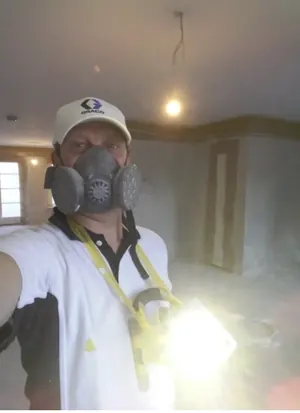
Latex spraying means applying latex paint to walls and ceilings with an airless spray machine instead of a roller. The paint is atomised under pressure and settles as an even coat on the surface. We always spray two coats, after masking, hand sanding and filling the inside corners.
On this page I explain how airless latex spraying works, what the pros and cons are and when you can do it yourself. Mainly want to know what it costs? Then see latex spraying cost per m2: spray work starts at €7.95 per m2 with us.
Airless latex spraying: how the machine works
An airless spray machine pumps up the paint and pressurises it without using air. That is stated in the brochure from Graco, a manufacturer we also work with. The pressure can climb high, up to 207 bar on the machine in that brochure. You start at the lowest pressure setting and raise it gradually until the coat of paint is even.
The spray tip determines how wide and how fine the jet is. Graco explains the tip code like this: the first digit times 5 is the spray width in centimetres at a distance of 30 cm, and the last two digits are the opening in thousandths of an inch. A 515 tip therefore sprays roughly 25 cm wide with an opening of 0.015 inch.
Paint has to be strained before spraying, otherwise the tip clogs. It is also important to keep about 30 cm distance from the wall at all times. We set the pressure and tip to suit the latex we use, so that the result is even.
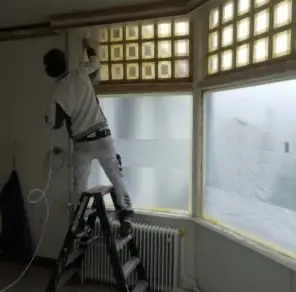
Spraying latex paint: data from the technical data sheet
Every latex has its own application data. As an example we take the data sheet for Sigma Air Pure Supermatt. For airless spraying the sheet gives a nozzle opening of 0.018 to 0.021 inch (about 0.46 to 0.53 mm) and a spray pressure of 16.5 MPa, roughly 165 bar. The paint may be thinned with 0 to 10 per cent of tap water by volume.
On drying, the same sheet says: dry after about 1 hour and overpaintable after 4 hours, at 23 degrees and 50% relative humidity. The coverage is 7.5 to 10 m2 per litre. Another example is wall paint from Flexa: touch dry after 1 hour at 20 degrees and overpaintable after 4 hours, with about 10 m2 per litre. That paint may not be applied below 10 degrees.
These are examples, not data on every product we use. We always follow the sheet for the paint chosen for your job.
Spray painting walls and ceilings: our method
How do we approach a job? These are the steps for an average room:
- Site visit and check of the surface.
- Masking of windows and frames and covering of floors.
- Hand sanding of walls and ceilings and carrying out small repairs.
- Filling of all inside corners.
- Spraying two coats of latex.
- Clearing up and going through the handover together.
You will find everything about walls on wall spraying. The approach for ceilings, including costs, is covered under spray painting ceilings.
How fast is latex spraying? Spraying time per room and per home
In our experience, latex spraying goes up to 5 times faster than traditional rolling. The airless machine atomises the latex paint under high pressure, so large walls and ceilings are evenly covered in a short time, without roller marks.
| Space | Spraying time (in practice) | Where the time goes |
|---|---|---|
| Standard room of 12 to 20 m2 | 30 to 60 minutes per coat | Masking floor, frames and sockets |
| Living room: approx. 40 m2 of walls and 25 m2 of ceiling | A fraction of an hour of spraying | Covering and masking furniture takes most of the time |
| Family home of approx. 120 m2 | Often 1 to 2 days, prepared and finished | Including preparation, sanding, filling and two coats |
The spraying itself is lightning fast; careful masking and covering determine the schedule. That is why an empty home or a new build goes quickest. These are guidelines from our own experience; you will hear the schedule for your home after the free site visit.
Pros and cons of spraying latex on walls and ceilings
What are the disadvantages of latex spraying? It takes some extra preparation and it needs agreement on what stays in the room. Below you can see the main points, with a source where one exists.
| Topic | What it means | What we do about it |
|---|---|---|
| Spray mist | Wagner advises respiratory protection against overspray | We mask and wear protection |
| Surface | Homedeal: preferably wallpapered or smooth and ready for paint (sausklaar), existing texture stays visible | We check the surface and sand by hand |
| Preparation | Everything that must not get paint has to be shielded | Masking of windows and frames is in the price |
| Speed | Spraying is faster than rolling | Your home is finished sooner |
You can read more about the balance of pros and cons under pros and cons of latex spraying. The advantages include speed and an even finish: Wagner says spraying is up to four times faster than a brush or roller for beginners.
Can I spray latex myself or should I hire a latex sprayer?
Can I spray latex myself? Yes, with a suitable machine it is possible. Still, it is not just a matter of pulling the trigger. You have to set the pressure, choose the right tip, strain the paint and mask everything. A mistake in pressure or distance gives streaks or drips.
Thinking of renting a spray machine or buying one? Then first read DIY latex spraying. It lists the steps and pitfalls. If you are short of time or have many m2, a professional is often the simplest choice.
Latex spraying or rolling: what suits your job?
A small wall you can roll without much preparation. For a whole floor or a ceiling with many square metres, spraying is more interesting. Wagner also calls spraying more even and sometimes one coat is enough in a new build, although we always spray two coats ourselves.
I set out all the differences side by side on rolling or spraying latex. There you will also find an answer to the question of whether spraying is cheaper.
Drying time, coats and scrub class when spraying emulsion
After the first spraying the coat has to dry before the second coat follows. For Sigma and Flexa that is four hours at 20 to 23 degrees. That is a guide value from their technical sheets. In practice we schedule the second coat so that the first coat has dried sufficiently.
The scrub class determines how well the wall withstands scrubbing (the washability classes of NEN-EN 13300, where class 1 is the most washable). With us, Basic goes with class 3, Medium with class 2 and High with class 1. Read more about the choice on scrub class of latex. The matching prices are from €7.95, €9.95 and €11.95 per m2.
Latex spraying in Haarlem and the surrounding area
We are based in Haarlem and come to you. Latex spraying Haarlem in particular is our home area, but the service area reaches 30 km around the city. Whether you want a single room done or a whole home, we make a tailor-made quote.
Want woodwork sprayed too? Then you end up at lacquer spraying. Ask for a quote via request a quote and we will arrange a visit.
Brands we use for latex spraying
For walls and ceilings we choose latex from premium brands, matched to the room and the scrub class you need, sprayed with professional Graco equipment.



Source: Meesterspuiters partner overview, checked 6 October 2026. Graco makes professional spraying equipment (graco.com).
Frequently asked questions
What is latex spraying?
Latex spraying is applying latex paint with an airless spray machine. The paint is atomised under pressure and forms an even coat on walls and ceilings, without roller marks.
How does airless latex spraying work?
An airless machine pumps up the paint and pressurises it without air, according to Graco. You start at a low pressure and raise it until the coat is even. The tip determines the width of the jet.
How long does it take to spray latex in a room?
In our experience, one coat of latex takes on average 30 to 60 minutes for a room of 12 to 20 m2. A whole family home of around 120 m2 is often finished in 1 to 2 days, including preparation. Most of the time goes on masking.
What are the disadvantages of latex spraying?
You have to mask more, spray mist is created that you protect yourself against, and the surface has to be well prepared. Because we take that preparation on ourselves, you notice little of it.
Can I spray latex myself?
Yes, with a suitable machine, but it takes experience with pressure, tip and distance. Mistakes give streaks or drips. Read more in our explanation of DIY latex spraying.
How much does latex spraying cost per m2?
With us from €7.95 per m2 for Basic, from €9.95 for Medium and from €11.95 for High. Those are "from" prices for light colours and one colour per quote. The exact price is in the quote.
How long does latex take to dry?
According to the Sigma data sheet, the paint is dry after about 1 hour and overpaintable after 4 hours at 23 degrees and 50% humidity. Flexa gives touch dry after 1 hour and overpaintable after 4 hours at 20 degrees for its wall paint.
Can walls and ceilings be sprayed in one go?
Yes, we spray walls and ceilings in the same job. We mask, sand, fill the inside corners and spray two coats. That way the house is tidy again in one go after handover.
Which surface is suitable for spraying?
Preferably a wallpapered or smooth, paint-ready (sausklaar) surface, writes Homedeal. Existing texture remains visible after spraying. At the site visit we check the surface and discuss what is needed.
How do I request a quote for spray work?
Fill in the form on the contact page or call or WhatsApp +31 6 38048347. We come round, look at the rooms and send a quote including the VAT (btw) amount.
More about spray painting walls and ceilings
- spray painting in Haarlem
- latex spraying Amsterdam
- service area around Haarlem
- knowledge base on latex and lacquer spraying
- free quote
 Written by Sander, latex sprayer at Meesterspuiters in Haarlem, with more than 10 years of experience in latex and lacquer spraying. Updated on 6 October 2026. More background in our knowledge base.